EMDR
What to do when nothing comes up in EMDR?
Reading time: 5 minutes
Reading time: 5 minutes


Dr Edouard Bougueret
•
EMDR
Psychotraumatology
Trauma (Big T / little t)
Complex PTSD
Dr Edouard Bougueret
•
EMDR
Psychotraumatology
Trauma (Big T / little t)
Complex PTSD
In EMDR therapy, there is a moment that destabilizes almost all practitioners, especially when starting out in practice. The bilateral stimulation begins, the therapist observes, and the patient remains silent. Then they say: "I don't know", "I feel nothing", "nothing is coming". The reprocessing seems to stop, and doubt sets in: is the target wrong? Is the patient resisting? Should we persist?
This article offers a more useful way to approach these situations. The central idea can be summed up in one sentence: in EMDR, when nothing comes, it is almost never a dead end. It is clinical information, which indicates where to look and how to adjust, without forcing.
"Nothing" is not a void, it is a signal
The underlying model of EMDR therapy, the Adaptive Information Processing model, starts from a simple idea: the brain naturally tends to digest difficult experiences, and trauma blocks this movement. In this context, the absence of associations is not a failure of the method. It is a sign that a condition for reprocessing is not being met at that moment.
First and foremost, it is useful to translate the patient's word into clinical observation. "Nothing" can mean several very different things: no image or sensation appears, the material is there but is not moving, the content is present but the emotion is cut off, or something is actively blocking access. This first distinction already guides what comes next.
A simple question helps to qualify this "nothing": "What does this nothing look like: rather empty, blurry, distant, blocked, frozen, or calm?" A calm nothing does not call for the same response as a frozen or forbidden nothing. The first can be a silent integration, the second a departure from the window of tolerance, the third an internal protection.

Why nothing comes: common clinical hypotheses
Rather than jumping too quickly to the conclusion of "resistance", it is more productive to review a few hypotheses, from the simplest and most reversible to the most structural.
The target is too vague. Working on "my childhood", "my father" or "the accident" scatpers the activation. The targeted network is too broad, and the system does not know where to go. We do not reprocess the entire city of memory, we choose a street, sometimes a single precise scene.
The patient is too much in control/protection. Some want to "do EMDR well", looking for the right image, the right emotion. This self-monitoring blocks spontaneous association. The patient is no longer observing, they are searching.
The patient is in hypoactivation. They recount the scene but do not actually connect with it. The story is accessible, the emotion absent. To be approached with caution, as this distancing can itself be protective.
The patient is too activated and cuts off. Sometimes, nothing comes because too much might come. The nervous system cuts off access to avoid overwhelm. The patient may seem calm when they are actually frozen.
A protective part is blocking access. The "nothing" can be an internal protection, which fears an emotional surge, shame, a loss of control, or a crisis after the session. The blockage is therefore not an enemy: it has a function.
Shame closes off access. Shame cuts off gaze, speech, body, and memory. The patient does not say "I am ashamed", they say "this is ridiculous", "it's not important", "I'm useless".
Other factors deserve to be explored: naturally difficult access to the body, another target that is more active than the one chosen, or simply an unfavorable state on the day (fatigue, sleep, substances that dull affect).
The window of tolerance, a central benchmark
Reprocessing is only possible within the optimal activation zone, the window of tolerance, where the patient can remain in contact with difficult material while maintaining sufficient presence. Outside of this zone, reprocessing becomes less reliable, and sometimes less safe.
The "nothing" often signals an exit from this window, most often from below: numbness, emptiness, drowsiness, blank stare, a feeling that the room is far away. These signs point to a dissociative cutoff, which is not always spectacular. The patient does not collapse, does not panic, even seems calm, but becomes less present. In this case, the priority is not to relaunch the target, but to bring the patient back to the present.

What to do concretely when nothing comes
The general logic is held in a few steps, from the least to the most intrusive, keeping in mind one principle: slowing down is not failing.
We start by checking the procedure: restating the instruction ("let whatever comes come, even if it seems unrelated, even if tiny"), narrowing the target to a precise scene, ensuring that the memory was actually activated before launching the stimulation. This is the most cost-effective and most often forgotten intervention.
We then check the presence and the window of tolerance: is the patient here, can they feel their feet, maintain dual attention? If they are outside the window, we regulate above all, through orientation to the present, simple physical contact, returning to resources.
If the target is correct but the process loops, a brief cognitive interweave can relaunch the movement: a short sentence that reintroduces safety, responsibility, or an adult perspective, then we relaunch the stimulation and observe. The interweave is a relaunch, not a discussion.
If the system is protecting itself (protective part, blankness, dissociation), we speak to the protection rather than forcing: acknowledge its function, ask what it is protecting from, what it would need to accept a very small step. This stance is often more reassuring for patients with complex trauma.
Finally, if the impasse persists, we can trace back from the current trigger to the source memory (float-back), or decide that the work just for today is to understand the blockage, not to push through it by force. Stepping back toward stabilization is not a failure, it is a clinical decision.
What to avoid
A few reflexes increase pressure and close off access. Saying "look harder" or "there must be something" reinforces performance and control. Concluding too quickly that there is resistance loses subtlety: what we call resistance is often fear, shame, protection, or a lack of safety. And continuing the standard protocol while the patient is cutting off can turn the session into re-traumatization. The right move, in case of doubt, is to slow down.
In summary
When a patient says "nothing is coming" in EMDR, the right question is not "how do I make something come?", but "what does this nothing tell me about the safety, the target, the body, or the patient's protections?". The block is not a wall, it is a gateway to a deeper understanding of the person's system in front of us. Clinical competence consists in discerning whether to continue, slow down, retarget, resource, stabilize, or supervise.
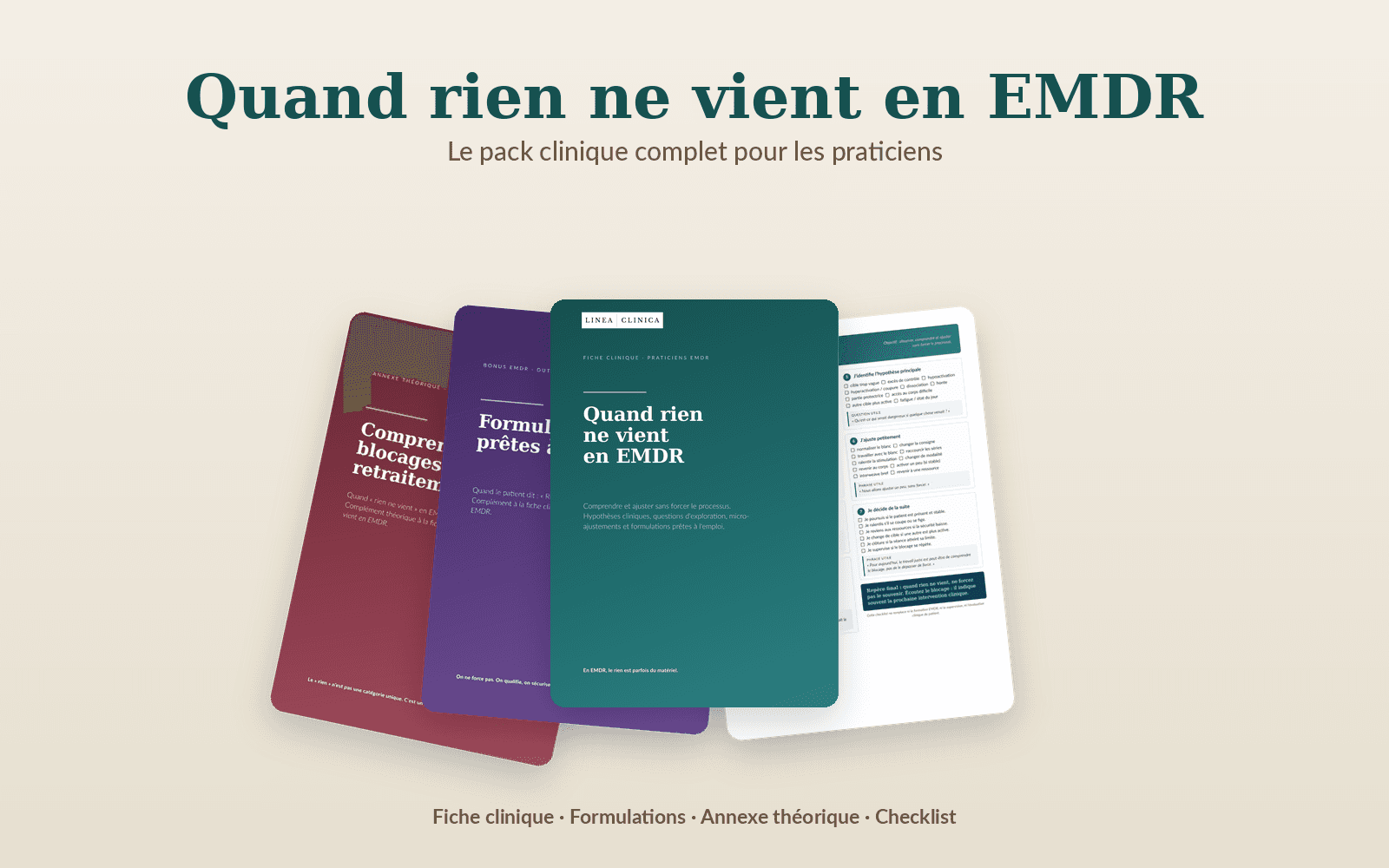
To go further I have gathered my troubleshooting benchmarks on this topic in a resource pack for EMDR practitioners: a clinical sheet detailing these hypotheses, a collection of ready-to-use session wordings, a theoretical appendix, and a checklist to print out for the office. Discover the "When nothing comes in EMDR" pack
In EMDR therapy, there is a moment that destabilizes almost all practitioners, especially when starting out in practice. The bilateral stimulation begins, the therapist observes, and the patient remains silent. Then they say: "I don't know", "I feel nothing", "nothing is coming". The reprocessing seems to stop, and doubt sets in: is the target wrong? Is the patient resisting? Should we persist?
This article offers a more useful way to approach these situations. The central idea can be summed up in one sentence: in EMDR, when nothing comes, it is almost never a dead end. It is clinical information, which indicates where to look and how to adjust, without forcing.
"Nothing" is not a void, it is a signal
The underlying model of EMDR therapy, the Adaptive Information Processing model, starts from a simple idea: the brain naturally tends to digest difficult experiences, and trauma blocks this movement. In this context, the absence of associations is not a failure of the method. It is a sign that a condition for reprocessing is not being met at that moment.
First and foremost, it is useful to translate the patient's word into clinical observation. "Nothing" can mean several very different things: no image or sensation appears, the material is there but is not moving, the content is present but the emotion is cut off, or something is actively blocking access. This first distinction already guides what comes next.
A simple question helps to qualify this "nothing": "What does this nothing look like: rather empty, blurry, distant, blocked, frozen, or calm?" A calm nothing does not call for the same response as a frozen or forbidden nothing. The first can be a silent integration, the second a departure from the window of tolerance, the third an internal protection.
Why nothing comes: common clinical hypotheses
Rather than jumping too quickly to the conclusion of "resistance", it is more productive to review a few hypotheses, from the simplest and most reversible to the most structural.
The target is too vague. Working on "my childhood", "my father" or "the accident" scatpers the activation. The targeted network is too broad, and the system does not know where to go. We do not reprocess the entire city of memory, we choose a street, sometimes a single precise scene.
The patient is too much in control/protection. Some want to "do EMDR well", looking for the right image, the right emotion. This self-monitoring blocks spontaneous association. The patient is no longer observing, they are searching.
The patient is in hypoactivation. They recount the scene but do not actually connect with it. The story is accessible, the emotion absent. To be approached with caution, as this distancing can itself be protective.
The patient is too activated and cuts off. Sometimes, nothing comes because too much might come. The nervous system cuts off access to avoid overwhelm. The patient may seem calm when they are actually frozen.
A protective part is blocking access. The "nothing" can be an internal protection, which fears an emotional surge, shame, a loss of control, or a crisis after the session. The blockage is therefore not an enemy: it has a function.
Shame closes off access. Shame cuts off gaze, speech, body, and memory. The patient does not say "I am ashamed", they say "this is ridiculous", "it's not important", "I'm useless".
Other factors deserve to be explored: naturally difficult access to the body, another target that is more active than the one chosen, or simply an unfavorable state on the day (fatigue, sleep, substances that dull affect).
The window of tolerance, a central benchmark
Reprocessing is only possible within the optimal activation zone, the window of tolerance, where the patient can remain in contact with difficult material while maintaining sufficient presence. Outside of this zone, reprocessing becomes less reliable, and sometimes less safe.
The "nothing" often signals an exit from this window, most often from below: numbness, emptiness, drowsiness, blank stare, a feeling that the room is far away. These signs point to a dissociative cutoff, which is not always spectacular. The patient does not collapse, does not panic, even seems calm, but becomes less present. In this case, the priority is not to relaunch the target, but to bring the patient back to the present.
What to do concretely when nothing comes
The general logic is held in a few steps, from the least to the most intrusive, keeping in mind one principle: slowing down is not failing.
We start by checking the procedure: restating the instruction ("let whatever comes come, even if it seems unrelated, even if tiny"), narrowing the target to a precise scene, ensuring that the memory was actually activated before launching the stimulation. This is the most cost-effective and most often forgotten intervention.
We then check the presence and the window of tolerance: is the patient here, can they feel their feet, maintain dual attention? If they are outside the window, we regulate above all, through orientation to the present, simple physical contact, returning to resources.
If the target is correct but the process loops, a brief cognitive interweave can relaunch the movement: a short sentence that reintroduces safety, responsibility, or an adult perspective, then we relaunch the stimulation and observe. The interweave is a relaunch, not a discussion.
If the system is protecting itself (protective part, blankness, dissociation), we speak to the protection rather than forcing: acknowledge its function, ask what it is protecting from, what it would need to accept a very small step. This stance is often more reassuring for patients with complex trauma.
Finally, if the impasse persists, we can trace back from the current trigger to the source memory (float-back), or decide that the work just for today is to understand the blockage, not to push through it by force. Stepping back toward stabilization is not a failure, it is a clinical decision.
What to avoid
A few reflexes increase pressure and close off access. Saying "look harder" or "there must be something" reinforces performance and control. Concluding too quickly that there is resistance loses subtlety: what we call resistance is often fear, shame, protection, or a lack of safety. And continuing the standard protocol while the patient is cutting off can turn the session into re-traumatization. The right move, in case of doubt, is to slow down.
In summary
When a patient says "nothing is coming" in EMDR, the right question is not "how do I make something come?", but "what does this nothing tell me about the safety, the target, the body, or the patient's protections?". The block is not a wall, it is a gateway to a deeper understanding of the person's system in front of us. Clinical competence consists in discerning whether to continue, slow down, retarget, resource, stabilize, or supervise.
To go further I have gathered my troubleshooting benchmarks on this topic in a resource pack for EMDR practitioners: a clinical sheet detailing these hypotheses, a collection of ready-to-use session wordings, a theoretical appendix, and a checklist to print out for the office. Discover the "When nothing comes in EMDR" pack

Stay informed about new publications
New publications, kit updates, curated resources. Sent occasionally, without spam.
Stay informed about new publications
New publications, kit updates, curated resources. Sent occasionally, without spam.
Stay informed about new publications
New publications, kit updates, curated resources. Sent occasionally, without spam.